Romania has entered a new phase of political uncertainty after Prime Minister Ilie Bolojan’s government was dismissed by Parliament following a no-confidence motion backed by PSD, AUR and PACE.
The vote took place on Tuesday, 5 May, only days after the government lost its majority in Parliament. The motion passed with 281 votes in favour, far above the 233 required to remove the government. Only four MPs voted against. Digi24 reported that the result effectively brought down the Bolojan cabinet, while Reuters said the collapse raises concerns over Romania’s sovereign debt rating, access to EU funds and the stability of the leu.
For readers following Cluj XYZ’s recent coverage, this is the direct continuation of the article published before the vote, which looked at the risk of far-right influence growing as the government faced a decisive parliamentary test. That risk has now moved from possibility to fact. AUR did not simply criticise the government from the sidelines. It played a direct role in helping remove it.
The immediate political issue is now no longer whether Bolojan survives. He does not. The larger question is what replaces his government, how quickly a new majority can be formed, and how much leverage AUR will have over the next stage of Romanian politics.
The motion followed PSD’s withdrawal from the governing coalition, which left Bolojan’s pro-European administration without a parliamentary majority. PSD then moved against the government alongside AUR and PACE. AGERPRES reported when the motion was submitted that it was tabled by the parliamentary groups of PSD, AUR and PACE, under the title “STOP the Bolojan Plan”, with supporters accusing the government of damaging the economy and impoverishing the population.
On paper, no-confidence motions are part of Romania’s parliamentary system. What makes this one politically significant is the alignment behind it. PSD is one of Romania’s main establishment parties, while AUR has built its support as a nationalist and anti-establishment force. PSD has argued that the move was about removing Bolojan’s government, not forming an alliance with AUR. However, the vote still gives AUR a central role in the fall of a national government.
Cluj-Napoca Mayor, Emil Boc, Weighs In
That concern was raised before the vote by Cluj Mayor Emil Boc, a senior PNL figure and former prime minister. Speaking to Digi24, Boc argued that the parties bringing down the government had “put the cart before the horse” by creating a government crisis without first presenting a replacement. He compared Romania’s approach unfavourably with countries such as Germany, where a government can be removed through a constructive vote of no confidence only when a replacement is ready.
Boc’s central argument was that ordinary Romanians, rather than politicians, would pay the cost of the crisis. He said that regardless of which political actor claimed victory, “Romanians lose from this game”. His warning now carries more weight, because the government has fallen without a clear replacement majority already in place.
PNL’s position, as described by Boc, was also clear. If PSD, AUR and other parties remove the government, they should also have the political and moral responsibility to form the next one. Boc said PNL would not act as a “buttonhole party” for another political force and suggested that, if the motion passed, it was logical for those who created the new majority to produce a new government.
This matters because it makes the next stage harder. Removing a government required 233 votes. Forming a durable replacement requires a workable majority, a prime ministerial candidate acceptable to Parliament, and enough agreement on economic policy to survive the coming months.
Boc said PNL’s preferred option before the vote was still the continuation of the existing pro-European coalition, without the motion going ahead. He called for another coalition meeting, a political “time-out”, and detailed renegotiation of the governing programme between pro-European parties. In his view, Romania has a habit of forming governments quickly and negotiating the real details later, unlike Western European coalition systems where parties can spend months agreeing a programme before taking office.
Those comments now frame the problem facing President Nicușor Dan. With the Bolojan cabinet dismissed, the president must begin consultations and identify a candidate capable of forming a new government. The president is expected to try to rebuild a pro-European coalition, possibly under another Liberal figure or a technocratic prime minister, while early elections remain unlikely.
Bolojan does not leave Victoria Palace immediately. A dismissed government remains in place in a caretaker capacity until a new cabinet is approved. Boc stressed this point before the vote, recalling that after his own government was removed by a no-confidence motion, he remained caretaker prime minister for three months because no replacement government could be formed.
RON Falls as Government Falls
That is now one of the main risks. Romania may not only face a change of government, but a prolonged interim period with limited executive powers at a time when economic decisions are urgent.
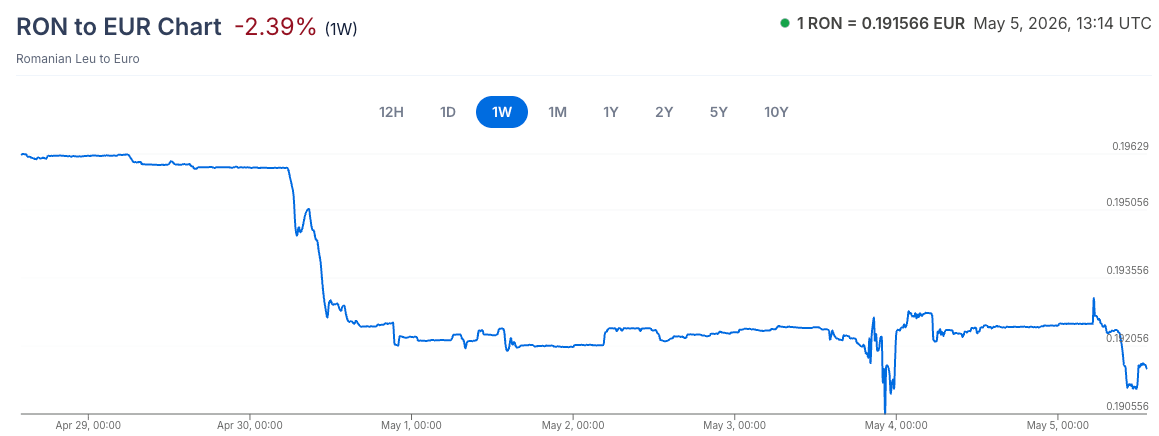
The economic stakes are significant. Romania is under pressure to reduce a large budget deficit and implement reforms linked to European Union funding. More than €10 billion in EU recovery funds are at stake before an August deadline, while the leu (RON) has reached a record low against the euro during the political turmoil.
PSD argues that Bolojan’s government failed to deliver meaningful reform and placed too much pressure on the population through tax increases, spending cuts and unpopular economic measures. The former government argued that fiscal tightening was necessary to stabilise public finances and protect access to European funding.
Boc defended Bolojan before the vote, saying there was no reason for PNL to remove him as party leader and that he had done his duty both to Romania and to the party. He described Bolojan’s offer as the chance of a “normal, modern, European Romania” capable of passing through the current storm without citizens paying the price for political disputes.
The political optics are therefore difficult. AUR helped remove a pro-European government, PSD remains essential to any stable majority, PNL is signalling that those who brought down the cabinet should take responsibility for the next one, and President Dan must now try to find a governing formula that can pass through Parliament.
AP reported that PSD and the hard-right AUR supported the motion, while Bolojan’s coalition partners, including PNL, USR and UDMR, abstained from the vote rather than voting against it. AP also noted that Romania now faces fresh political turmoil, with no party holding a clear majority and analysts expecting a period of instability.
There is no immediate indication that Romania’s position within the European Union or NATO is changing. The risk is more gradual. Repeated political crises, economic pressure and public frustration may create more space for nationalist and anti-establishment parties to shape the national agenda, even without formally entering government.
This is why the vote mattered beyond the fall of one cabinet. It showed that AUR can influence major political outcomes when Romania’s mainstream parties are divided. The next test is whether the pro-European parties can rebuild a stable majority without repeating the disputes over reform, spending and trust that brought down Bolojan’s government.
The significance of AUR’s role has also been picked up internationally. Major European and international outlets gave prominent coverage to the fall of the Bolojan government, with Politico describing George Simion as a central figure behind the collapse. The same reporting noted that PSD’s cooperation with AUR has placed the Socialists and Democrats group in the European Parliament in an uncomfortable position, given its previous criticism of centre-right parties that worked with far-right forces elsewhere in Europe. This gives the crisis a wider European dimension, not only because of Romania’s domestic instability, but because of what it signals about the growing leverage of nationalist parties inside mainstream parliamentary politics.
For now, the Bolojan government is over. What comes next is less clear.
Romania has a dismissed cabinet, an interim administration with limited powers, a president preparing consultations, an economy under pressure, and a far-right party that has just demonstrated its ability to influence the fate of a national government.
The crisis has not ended. It has moved into its next stage.