From celebration to hatred: how two Cluj events triggered waves of xenophobic comments
Cluj-Napoca has spent years building an image of itself as a modern European city. It promotes itself through major festivals, an international student community, multicultural events and a growing reputation as one of Romania’s most internationally connected cities. That is the version of Cluj many residents proudly point to when describing the city to outsiders.
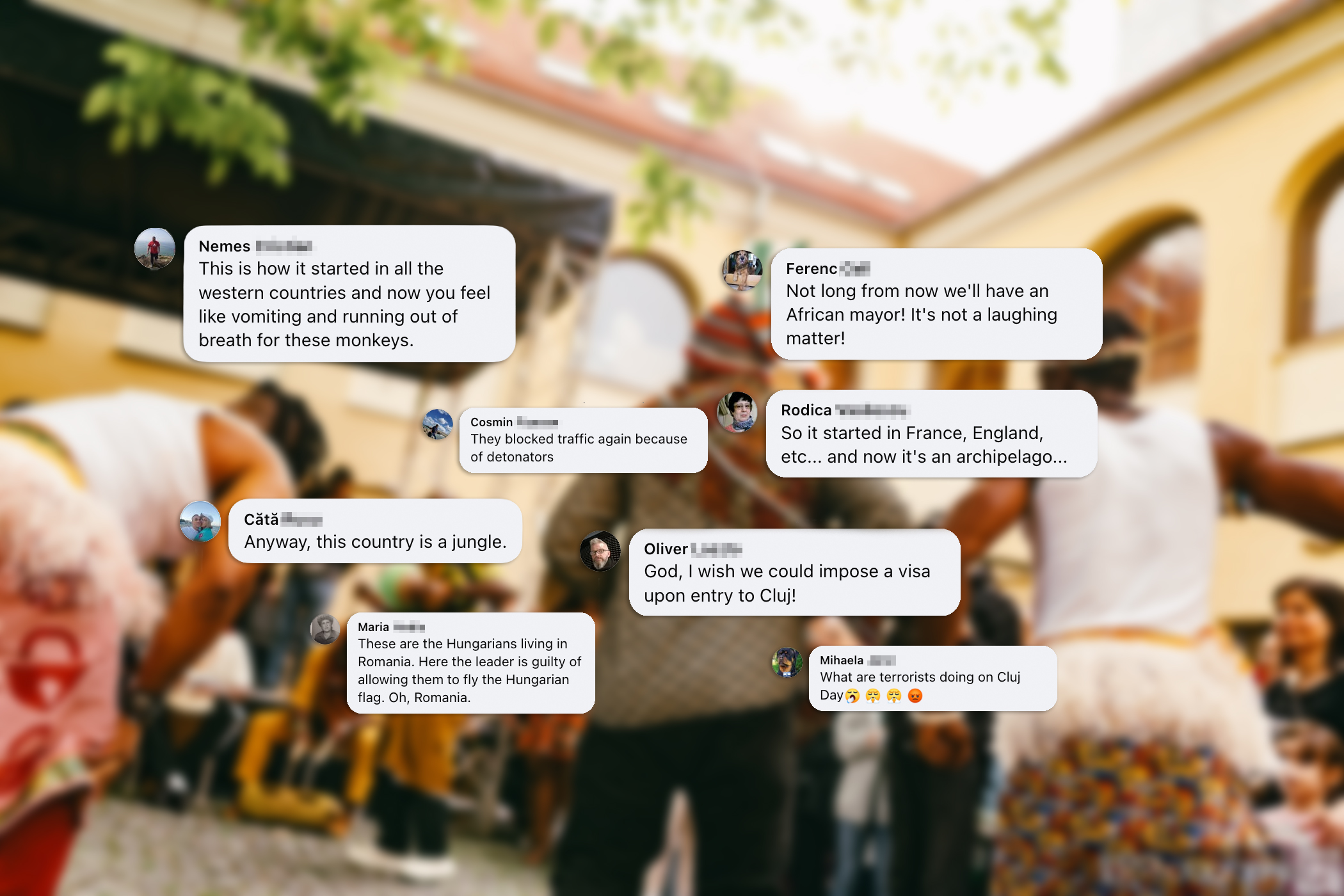
But over the last week, the reactions underneath two public cultural events showed a very different side of the city online.
Videos connected to Africa Day celebrations in Cluj and multicultural moments during Zilele Clujului quickly filled with comments about “foreigners”, “Romanian DNA”, “the West being destroyed by diversity” and fears that Cluj is somehow being “taken over”. Under posts featuring Ukrainian participants, some commenters told them to “go fight on the front”, while others questioned why foreign cultures should be celebrated in Romania at all.
Many of the comments were openly racist. Others drifted into anti-Hungarian rhetoric, anti-refugee talking points or broader nationalist narratives that have become increasingly common online in recent years.
- “S-a umplut Clujul și de negrii?!” (“Cluj has filled up with black people?!”)
- “ADN de dac va dispărea.” (“Dacian DNA will disappear.”)
- “Țigănie maximă.” (“Maximum gypsy chaos.”)
- “Diversitatea a distrus occidentul.” (“Diversity destroyed the West.”)
- “Mergeți pe front.” (“Go fight on the front.”)
What becomes clear after reading through hundreds of comments is that the hostility was not aimed at one single group. Different minorities became targets for different reasons, but they were all eventually pulled into the same wider narrative about outsiders, identity and fear of change.
African participants were often met with explicitly racial language. Several comments focused directly on skin colour, while others relied on stereotypes or mockery. Some compared the celebrations to a “jungle”, others questioned why African culture should be visible in Romania at all, while comments about “Romanian DNA disappearing” pushed the discussion into openly racial territory. One commenter reacted with “S-a umplut Clujul și de negrii?!” (“Cluj has filled up with black people?!”), while another claimed “Diversitatea a distrus occidentul” (“Diversity destroyed the West”).
The reactions aimed at Ukrainians carried a different tone. Under multicultural posts connected to Cluj Days, several commenters responded with variations of “Mergeți pe front” (“Go fight on the front”), despite many of the people visible in the videos being women and children attending public celebrations. The hostility directed toward Ukrainians appeared tied more to resentment surrounding the war and refugees, with commenters accusing Ukrainians of benefiting from Romania while avoiding military service.
Hungarians became targets through discussions about language, identity and Transylvania itself. Some commenters questioned why minority cultures should be publicly celebrated in Romania, while others drifted into long-running nationalist arguments about Hungarian communities speaking Hungarian publicly in parts of Transylvania. In several threads, discussions about Africa Day quickly spiralled into entirely separate ethnic and political arguments unrelated to the original event itself.
Roma people were also repeatedly used as a point of comparison or insult. Terms such as “țigănie” were used casually throughout the comments as shorthand for disorder, chaos or something undesirable. The word itself has long been used online as a derogatory insult directed toward Roma communities, but its casual appearance throughout these discussions showed how normalised this type of language remains.
LGBT people and migrants were frequently folded into the same conversations as well, despite having little or nothing to do with the original events. Comments referring to “the West”, “diversity”, “Muslims”, “foreigners” and “LGBT ideology” appeared repeatedly, often echoing rhetoric more commonly associated with far-right culture-war narratives spreading across Europe and social media generally.
That is what makes the reactions particularly uncomfortable. The comments were rarely about the events themselves. The Africa Day celebration, for example, was largely what anyone would expect from an intercultural event in a university city: music, dancing, performances, food and community gatherings in the centre of Cluj. Yet scrolling through the comments underneath, you would think people were reacting to some kind of political crisis rather than a public cultural event.
The contradiction is difficult to ignore. Cluj benefits enormously from being an international city. Its universities attract foreign students, multinational companies continue investing locally, and thousands of people from outside Romania now live, study or work here. The city markets itself heavily around openness, creativity and European values. But online, even relatively harmless public celebrations involving foreigners are increasingly met with hostility and panic about identity, culture and “what Romania is becoming”.
What makes the situation more concerning is how socially acceptable this rhetoric appears to have become. These were not isolated comments hidden away with no engagement. Many received likes, replies and support from other users. The conversations quickly stopped being about dancing, music or cultural exchange and instead became arguments about race, identity, immigration and whether certain groups “belong” in Cluj at all.
To be clear, many people also pushed back strongly against the xenophobia. Some commenters pointed out that millions of Romanians themselves live abroad and celebrate Romanian culture publicly in other countries. Others openly condemned the racism and questioned how this type of rhetoric is still so common in 2026.
And that is probably the most important part of the conversation.
This is not about claiming that Cluj is uniquely racist or pretending intolerance only exists in Romania. It is about acknowledging that a visible and increasingly normalised hostility toward minorities and foreigners exists online, even in places that proudly describe themselves as open and progressive.
Because if videos of people dancing in the centre of Cluj are enough to trigger discussions about “racial purity”, “foreign invasions” and whether certain ethnic groups belong in Romania, then the city clearly has a deeper problem it still does not want to confront honestly.