Romania is facing another major political test, with Prime Minister Ilie Bolojan’s government at risk of collapse after PSD joined AUR in backing a no-confidence motion expected to be debated and voted on next week.
The vote marks the latest stage in a political crisis that has been building since Romania’s disputed presidential election period, when the country was forced into unfamiliar constitutional territory. As previously reported by Cluj XYZ, Romania’s first round of presidential elections was annulled after the Constitutional Court cited evidence of foreign interference and serious electoral violations. That decision halted the electoral process, forced a restart, and raised wider questions about the resilience of Romania’s democratic institutions.
The crisis deepened further when far-right politician Călin Georgescu was barred from running in the rerun election. His exclusion led to protests from supporters and intensified the debate around Romania’s political direction, particularly the divide between nationalist and pro-European forces. Cluj XYZ also previously described the presidential election as a moment in which Romania faced a choice between two very different visions for its future.
That same divide is now playing out in Parliament.
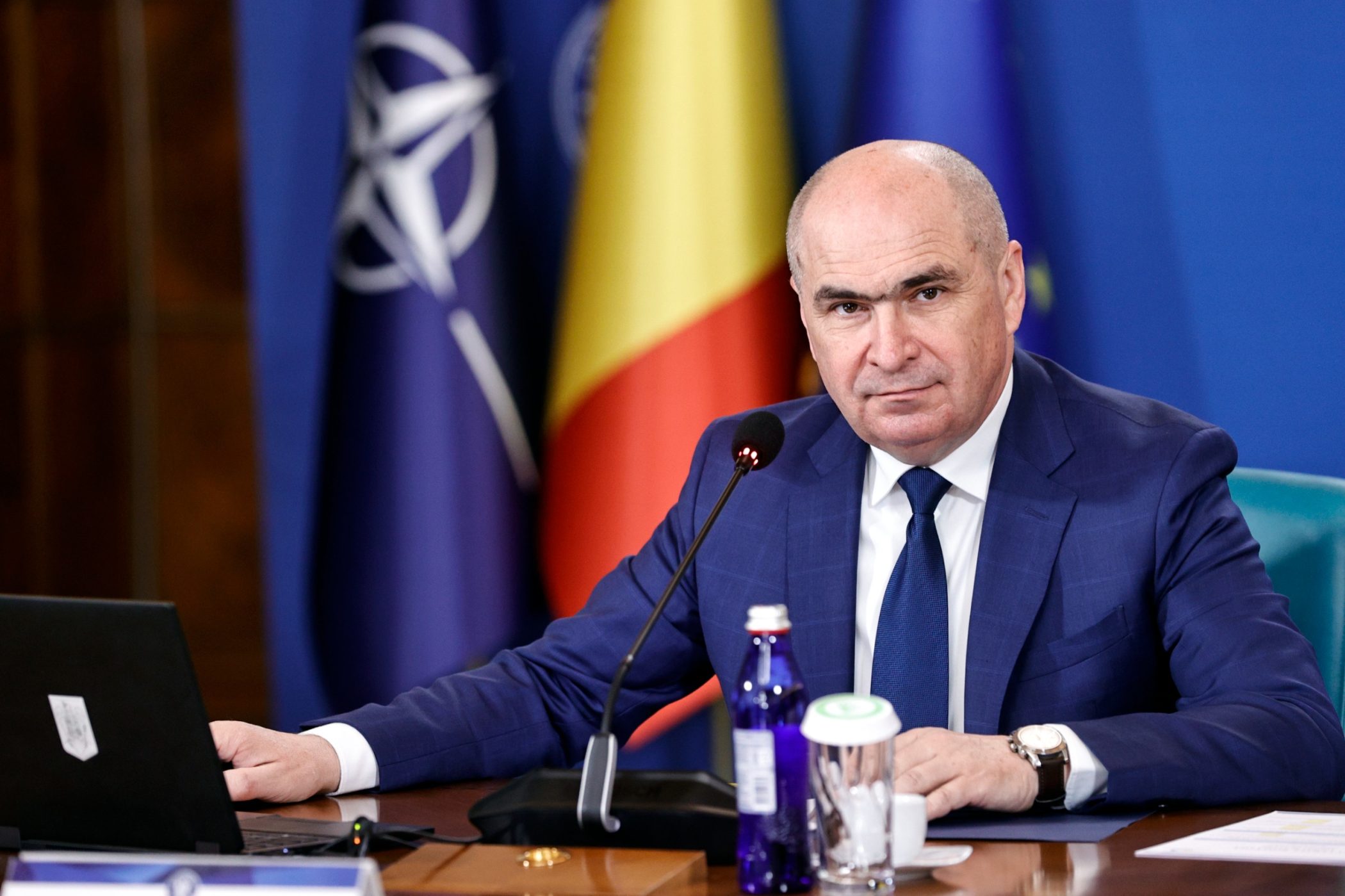
The immediate trigger for the current situation was PSD’s withdrawal from the governing coalition. The Social Democrats pulled their ministers from the government, leaving Bolojan’s pro-European administration without a parliamentary majority. PSD then moved to support a no-confidence motion alongside AUR, the nationalist party led by George Simion.
The motion was formally submitted on 28 April and had gathered 253 signatures, above the 233 votes required for it to pass in Parliament. The motion is expected to be read before being debated and voted on next Tuesday. The vote is expected around 5 May.
On paper, no-confidence motions are part of the normal parliamentary process. What makes this moment more significant is the political alignment behind it. PSD is one of Romania’s main establishment parties, while AUR has built its support as a nationalist and anti-establishment force. PSD insists that its cooperation with AUR is limited to removing the current government and does not represent a future coalition agreement, but the move has still raised concerns about the normalisation of far-right influence in parliamentary politics.
AUR’s role is central to the concern. Simion said the party contributed 90 of the 253 signatures and, while denying that AUR had formed an alliance with PSD, he avoided ruling out future cooperation entirely. He also said he supports early elections.

For Bolojan, the issue is not only whether the government survives, but what kind of majority could replace it. He has accused PSD and AUR of effectively preparing a new governing arrangement, warning that if the government falls, Romania could enter a transitional period with limited executive powers and greater instability. He also said that if the country does not maintain economic balance, every citizen will end up paying the cost in one form or another.
The concern is also being noticed outside Romania. Romania Journal, citing Politico, reported that some European figures were caught off guard by PSD’s cooperation with AUR, with criticism from the Greens focused on the idea that social democrats are working with the same kind of far-right forces they have previously warned against at European level. The report also noted that Romania, as a larger EU member state, is harder for Brussels to ignore than similar developments in smaller countries.
Behind the political confrontation is a serious economic dispute. Romania is under pressure to reduce a large budget deficit and implement reforms linked to European Union funding. Reuters reported that more than €10 billion in EU recovery funds could be at risk, while Bolojan’s government has argued that reforms are needed to bring the deficit down from over 9 percent in 2024 to 6.2 percent in 2026. Employers’ group Concordia has warned that losing Romania’s investment-grade credit rating could increase debt costs by around 100 billion lei over five years.
PSD argues that Bolojan’s government has failed to deliver meaningful reform and has instead placed pressure on the population through tax increases, spending cuts and economic measures that it says have weakened living standards. In its statement supporting the motion, PSD said Romania needs a government led by a prime minister willing to cooperate and capable of economic recovery.
If the no-confidence vote passes, the government will be dismissed and will continue only in a caretaker role with limited powers. President Nicușor Dan would then become central to the next phase, as he would need to consult parties and attempt to identify a new prime minister who can form a majority. Reuters has reported that if the government falls, Dan is expected to try to form a new pro-European coalition, potentially led by a different Liberal or by a technocratic figure.
Bolojan has said he has had good cooperation with President Dan and that the president did not ask him to resign before the motion. He also suggested that Dan’s ability to deliver on his own programme depends on having a functional relationship with the government, warning that without stable cooperation, the chances of implementing major projects are reduced.
If the motion fails, the government survives, but the crisis does not end. Reuters has reported that Bolojan would still need to seek a new confidence vote within 45 days because of the temporary mandates of interim ministers appointed after PSD left government.
This means that, whichever way next week’s vote goes, Romania is unlikely to return quickly to political stability.
The broader picture is that several pressures are now overlapping. Romania has already seen a presidential election annulled, a far-right candidate barred from the rerun, protests over the electoral process, a fragile coalition weakened by economic disputes, and now a no-confidence vote in which AUR has become a decisive parliamentary actor.
There is no immediate indication that Romania’s position within the European Union or NATO is changing. However, the risk is more subtle than that. The concern is that repeated political crises, economic pressure and public frustration are creating more space for far-right and anti-establishment forces to shape the national agenda.
Next week’s vote will decide the immediate fate of the Bolojan government. It may also show how far Romania’s political centre has shifted since the election crisis began.